Printing a Logo on Deli Paper: Spot Colors, Repeats and Coverage
By the team at Deli Papers ·
A logo that looks right on a menu board can vanish on a wrapped burger, print muddy on kraft or soak the sheet in ink. This guide walks through the print choices on deli paper, from a single spot color to full color, and the layouts that keep the mark visible after the fold.
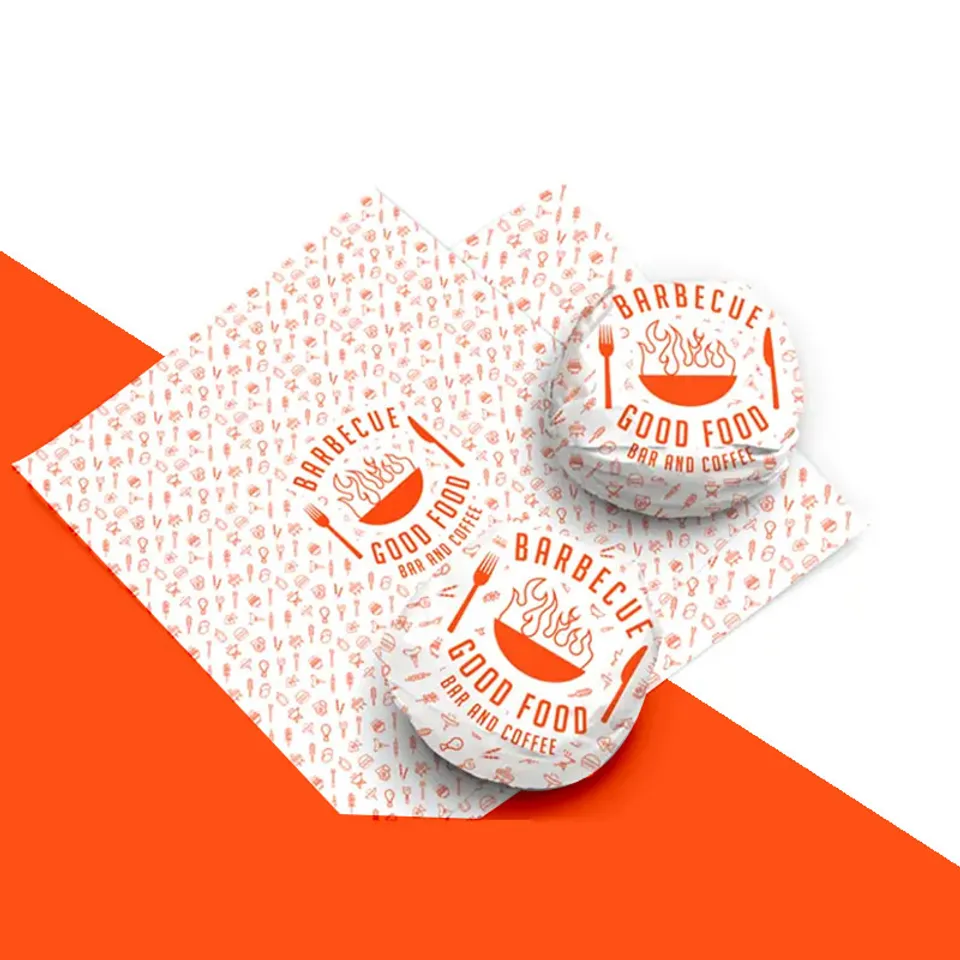
What does printing on deli paper actually involve?
Deli paper is printed on the outside face only, with soy and water-based inks that are food-safe for the job. The side that touches the food is never printed. The ink sits on an absorbent surface, which is why fine detail behaves differently here than on a glossy box or a label.
You choose a number of colors, a layout and a stock. The three decisions pull on each other. Full color needs a white stock. White ink needs a dark one. A repeat pattern wants a small, simple mark; a centered logo can carry more detail because it prints larger. Get the three in line and the proof will look like the printed sheet.
One spot color: the print that rarely goes wrong
A single spot color is the safest print on any stock. The logo is reduced to one solid color, printed in a repeat across the sheet. Red on white, black on kraft, white on black: these are the prints you see on most wrapped food in the country, and they look right because the contrast is high and there is nothing to misregister.
The fry paper in our photos is a one-color red word repeat on white, and it reads clearly even with fries spilling out of the fold. If your logo has a gradient, a photo or four brand colors, ask for a one-color version of it anyway. Many kitchens print that one on the paper and keep the full version for the sign.
Two and three spot colors: when the extra plate pays
A second color earns its place when the logo has two parts that need to read separately: a wordmark and a symbol, or a mark and a border. Red and black on white is a classic. A third color is for a brand with a fixed three-color identity, or for a pattern that uses one color for the logo and two for a background check or stripe.
Each color is a separate pass, and each pass has to line up with the last. On absorbent paper that alignment is good but not perfect, so keep colors from touching each other with thin outlines. Solid blocks that sit beside each other with a small gap print cleanly. A thin white keyline between a red and a black will not survive.
Pantone references are matched from a number or from a printed sample you send. The proof shows the closest match on the chosen stock, and a brand color on kraft will always sit darker than the same color on white.
Full color on white: photos, gradients and limits
Full color prints on the white stocks: grease-resistant white, bleached white and bleached dry wax. It suits a photo-style pattern, a logo with a gradient, or a bakery sheet with a watercolor floral. The result looks softer than the same file on a coated box, because the ink spreads a little into the fiber.
Two limits apply. Small text in full color goes fuzzy, so keep any wording in a solid spot color even on a full-color sheet. And heavy ink across the whole sheet stiffens it and can leave a faint smell when the case is first opened, so a full-color design should still leave plenty of white paper showing.
On kraft and black, full color is not offered. The taco wrap paper page shows how a brown sheet with a one-color print does the same job for a taqueria at a lower ink cost.
How does white ink print on kraft and black stock?
White ink is a spot color like any other, printed as a solid layer so it sits on top of a dark face instead of sinking in. On natural kraft it gives a light, bakery-counter look. On black stock it is the only print that reads well, and a white repeat on black under a pendant light is one of the sharpest sheets we make.
White ink covers less densely than a dark ink, so very thin lines and small type in white look lighter than the proof suggests. Keep white marks bold. A second bright color, such as a red or a gold, can sit alongside the white for a brand that needs it.
Why does a repeat pattern beat a single centered logo?
Picture a 12 x 12 sheet with one logo in the middle. A burger lands on the logo. The sheet folds over it twice and tucks. The logo is now on the bottom of the parcel, or split across a crease, or both. The customer never sees it.
A repeat puts the mark every two to three inches across the whole sheet. However staff fold, at least one complete logo lands on the top face. On a rolled burrito, the visible strip of paper around the middle always carries a full mark. On a basket liner, the marks show between the fries and the burger. That is why the repeat is the default layout on every product we print.
A repeat also forgives sloppy folding and odd portion sizes, which matter more at a busy counter than a perfectly placed logo ever will.
Corner marks and centered logos: when they work
The two single-position layouts have their uses. Both depend on the sheet being handled the same way every time.
- Corner mark on a wrap: works when the crew folds the same way and the marked corner becomes the top of the parcel
- Centered logo on a tray or basket liner: works because the sheet is laid flat and never folded
- Centered logo on a fry cone or scoop cup: works because the cone is always held one way up
- Centered logo on a bag face: works because the bag stands upright and the front is the front
- Centered logo on an interfolded sheet: works when the sheet is laid under food at a deli case
The printed basket and tray liner page is the one product where we suggest a centered logo as often as a repeat.
How much ink coverage is too much?
Coverage is the share of the sheet that carries ink. A small logo repeated every three inches covers a tenth of the sheet or less. A dense pattern with a colored background can cover most of it. Light coverage is cheaper, prints cleaner and leaves the paper feeling like paper.
Heavy coverage stiffens the sheet, dulls the fold and makes any misregistration visible. On grease-resistant stock a fully flooded background also shows every scuff from the stack. A good target for a wrap is a logo and perhaps a border, with most of the sheet unprinted.
If your brand needs a solid color field, consider ordering the sheet in a colored stock rather than printing the color. Black stock with a white mark gives a solid dark look without flooding white paper in black ink.
Matching a Pantone color on absorbent paper
The same Pantone number looks different on each stock. The table shows what to expect, so the proof does not surprise you.
| Stock | Dark spot color | Light spot color | Full color |
|---|---|---|---|
| Grease-resistant white | Close match, matte | Close match | Yes, slightly soft |
| Bleached white | Close match, brightest | Close match | Yes, best result |
| Dry wax | Close match, slight sheen | Close match on bleached | On bleached only |
| Grease-resistant kraft | Darker and warmer | Muted, use white ink instead | No |
| Natural kraft | Darker and warmer | Muted, use white ink instead | No |
| Black | Not visible | White ink only | No |
Send a printed sample of your brand color if you have one. A swatch on paper is matched more closely than a number read from a screen, and the proof is free to adjust before approval.
From file to printed sheet in six steps
- Send a vector logo as PDF, AI or EPS, or a clean PNG for a one-color mark, with the product, size and stock.
- Tell us the number of colors and any Pantone numbers, or send a printed swatch.
- Choose repeat, corner mark or centered. Place the file on a sheet photo on the Design Your Deli Paper page first if you want to see the spacing.
- A written quote arrives within one business day, then a free PDF proof shows the print on the sheet at final size.
- Ask for changes until it is right; they are free. Approve the proof in writing.
- Printing takes 4 to 6 business days, and free tracked delivery to any US address follows in 2 to 3 business days.
Each product and size is a run of at least 1,000 sheets, invoiced after approval. A misprint reported with photos within 10 days of delivery is reprinted or refunded.
Products Mentioned in This Guide
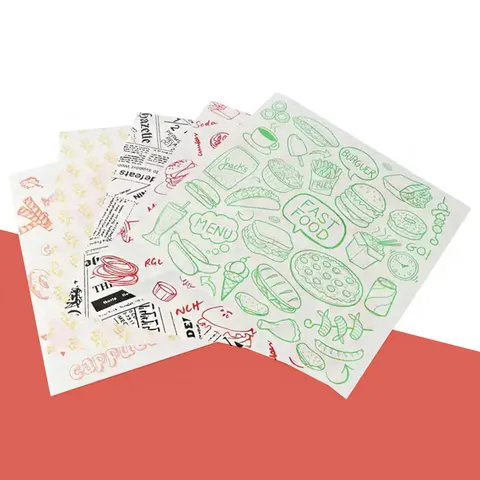 Custom Printed Deli PaperFrom $0.30 a sheet12 x 12 in. · 12 x 15 in. · 15 x 15 in.Sandwiches, burgers, counter service and tray lining with a logo or pattern
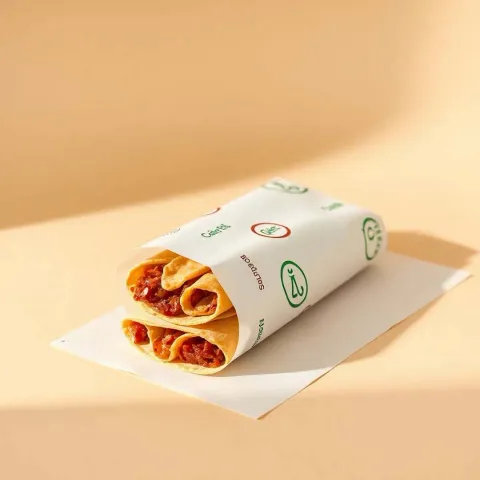 Taco Wrap PaperFrom $0.30 a sheet10 x 10 in. · 12 x 12 in. · 12 x 15 in.Tacos, gyros, shawarma and hand-held wraps
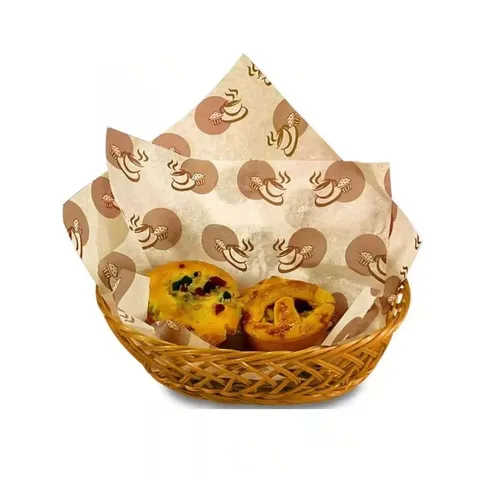 Printed Basket and Tray LinersFrom $0.30 a sheet12 x 12 in. · 12 x 15 in. · 15 x 15 in.Baskets, cafeteria trays and plates lined with your own print
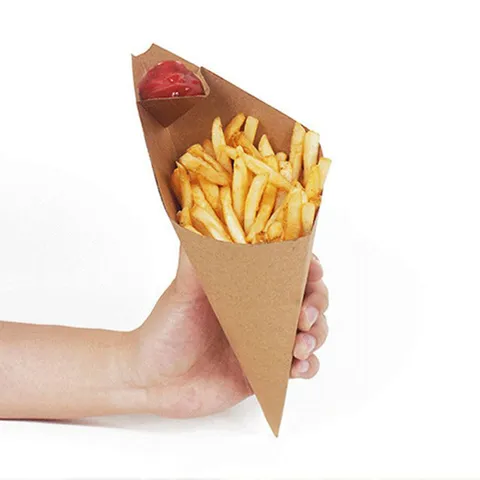 Fry Cones and HoldersFrom $0.30 a sheetSmall cone · Large cone · Scoop cupHand-held fries, popcorn chicken and street food portions
Questions About This Guide
The questions we answer most weeks. Pick a topic, open a row.
How many spot colors can be printed on deli paper?
One, two or three spot colors on any stock, each matched to a Pantone number or a printed sample. Full color is a fourth option on the white stocks only.
Does full color print on kraft deli paper?
No. Full color needs a white stock. On kraft the choices are dark spot colors or white ink, and a one-color print on kraft is the usual taqueria and barbecue order.
Why do you recommend a repeat pattern over a centered logo?
A repeat puts a complete logo on the top face however the sheet is folded. A centered logo on a wrap ends up under the food or across a crease once the burger is wrapped.
Can I print a photo on deli paper?
Yes, as a full-color print on grease-resistant white or bleached white. Expect a softer result than on a coated box, and keep any text in a solid spot color.
Will a Pantone color look the same on white and kraft deli paper?
No. On kraft the same number prints darker and warmer, and pale colors go muted. The proof shows the match on the stock you chose, and you can ask for a second proof on white.
Which stock gives the brightest printed logo?
Bleached white, followed closely by grease-resistant white. Both take spot and full color without dulling. For a dark sheet, white ink on black gives the sharpest contrast.
Is the ink used on printed deli paper food-safe?
The inks are soy and water-based and printed on the outside face only, so the food never touches a printed surface.
Does the number of ink colors change the minimum order?
No. The minimum stays at 1,000 sheets per product and size whatever the color count. More colors change the written quote, not the minimum.
Can I see the print on a real sheet before paying for a logo run?
Yes. A free PDF proof shows the print at final size on the chosen stock, and changes are free. Payment is by invoice after you approve the proof in writing.
Does a three-color print take longer to deliver than one color?
No. Every print runs 4 to 6 business days after approval and ships by free tracked delivery to any US address in 2 to 3 business days.
Tell us about your order
Send the product, a sheet size and roughly how many sheets you go through in a month. We reply in writing within one business day with a price and a free design proof. Prefer to talk? Call (503) 461-4788 or message us on WhatsApp.
- Minimum order 1,000 sheets
- Production in 4–6 business days after you approve the proof
- Free tracked delivery in the US in 2–3 business days
- Food-safe soy and water-based inks